What Can Sports Radar Actually Detect?
Separate radar detections, tracks, and sports metrics. Understand target detectability, missed events, false alarms, pose-estimation research, and a practical sports acceptance test.
What Can Sports Radar Actually Detect?
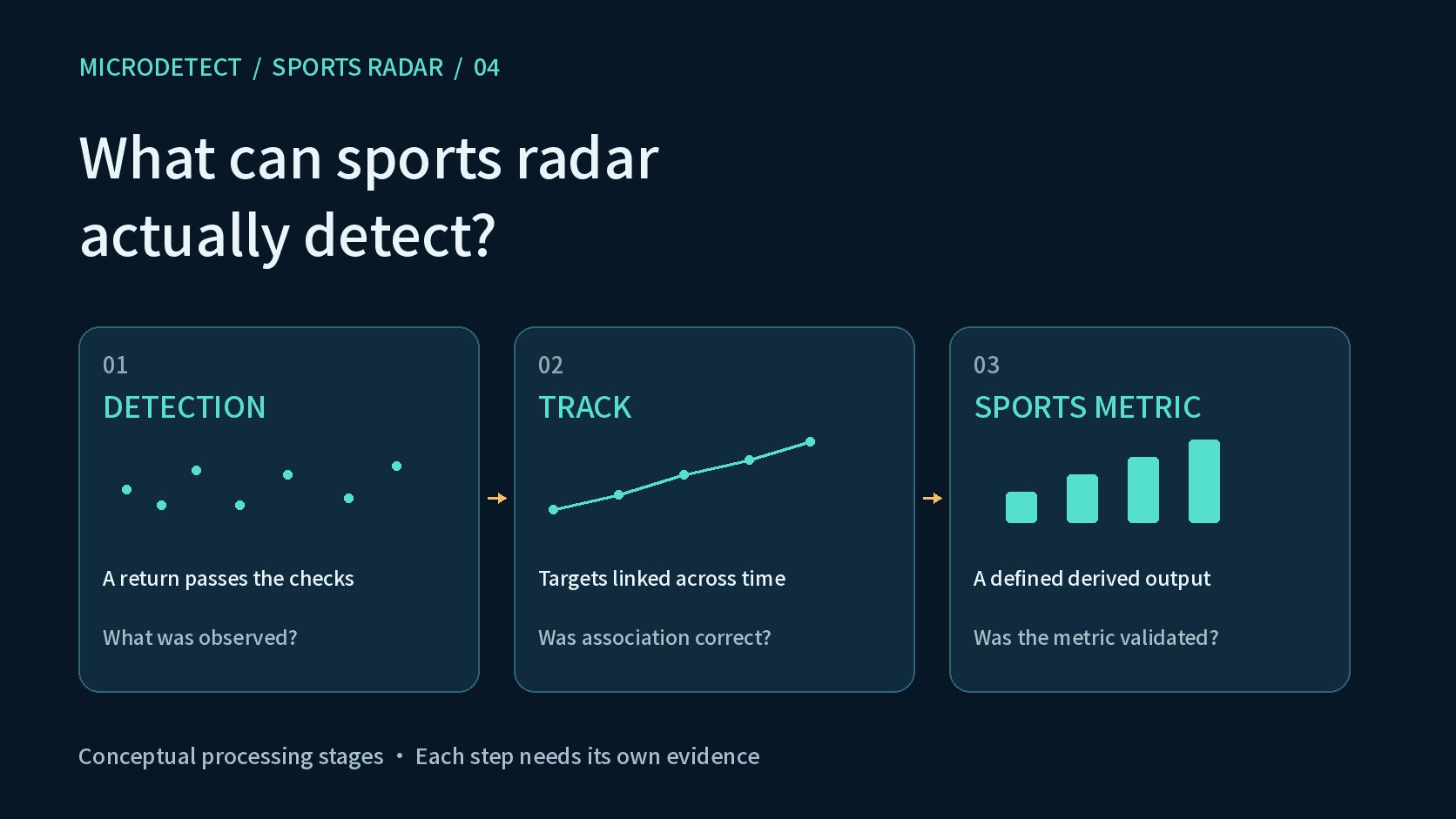
A sports radar demonstration shows a cloud of moving dots, followed by a ball trajectory and a training score. Those outputs can look like one measurement. In practice, each step answers a different question and needs its own evidence.
Edition 4 explains what a radar detection contains, why a target may disappear, and how to evaluate claims about tracking and human movement. The aim is to turn “can it detect a ball?” into a testable requirement.
A detection is a processing decision
Radar receives reflections. Signal processing then decides which returns qualify as detections under the selected configuration.
TI’s CFAR processing documentation provides a concrete implementation: candidate peaks must satisfy detection criteria and configured regions of interest. Depending on the processing mode, outputs can include position or range information, radial Doppler velocity, and noise and signal-to-noise information. This is documentation of a specific processing chain, not a universal output format for every radar.
A detection therefore represents a return that passed the algorithm’s checks. A point is not automatically an entire ball, a body joint, or one athlete. Confirm which fields the selected system actually exports, their units, coordinate frame, and validity conditions.
Separate detections, tracks, and sports metrics
A useful supplier review should ask for three outputs separately:
- Detection: What qualified return appeared at this observation time? Retain the measured attributes and quality information.
- Track: Which detections are associated with the same target across time? Identify updates based on observations and predictions made through missing observations.
- Sports metric: How is the track or signal converted into release speed, jump height, repetition count, or a technique score? Define the calculation and reference method.
TI’s motion-and-presence demo illustrates this separation with point-cloud processing, a tracker, and classification as different stages. Its people-sensing implementation does not establish performance for sports balls or fast athletic actions.
For a coaching application, ask where each displayed number comes from. A tracker identifier distinguishes algorithmic tracks; it does not by itself verify a player’s real identity.
Why a target can be present but undetected
Physical size alone is an insufficient guide to detectability. MathWorks’ radar-cross-section explanation describes how reflection depends on target shape, material, viewing geometry, and frequency. A stronger useful return generally improves the chance of detection.
For sports testing, this means that detecting a person cannot establish the range at which a particular ball will be detected. Test the actual target, orientation, distance, and surroundings. The dimensions of a ball do not directly specify its radar cross section.
Detection settings also matter. A target outside the configured region can be excluded, even if a return exists. Ask the supplier to record thresholds, processing mode, waveform, and any clutter filtering when a test is run. A change in software configuration can change the usable measurement envelope.
Detection probability is not an event-success guarantee
MathWorks’ statistical radar introduction distinguishes probability of detection from probability of false alarm at the resolution-bin level. These quantities describe a defined detection model. They are not automatically the fraction of serves successfully measured or the number of false shots reported per hour.
For a sports product, add application-level measures: attempts recorded correctly, missed attempts, false events, wrong-target tracks, and valid coverage of the relevant flight segment. Define the denominator and the matching rules before collecting results.
Here is a hypothetical accounting example, not a trial result: in 100 attempts, 90 produce a valid reading, eight are missed, and two select the wrong target. A speed-error report calculated only on the 90 valid readings must be accompanied by those ten unsuccessful attempts. Otherwise, a precise-looking error figure hides the availability problem.
Human pose is a researched inference
Radar-based pose estimation is a real research area, but skeletal joints are model outputs rather than labels attached to raw radar points.
The 2025 mmFree-Pose paper describes synchronized radar and inertial motion-capture annotations. It reports 4,534 aligned samples from three participants, with point-cloud attributes paired with 23-joint annotations, and evaluates learning models on the dataset. This is an experimental dataset and modeling study.
It does not establish that a generic radar can measure every athlete’s joints in a crowded venue. The small participant set is a reason to seek further evidence on new people, movements, and environments before transferring a result to a sports product. The same distinction applies to action classification: recognizing a learned movement category does not establish the accuracy of a biomechanical metric.
Turn a sports claim into a proposed acceptance test
The following is an editorial test proposal, not a reported experiment. Consider a single-lane tennis-serve pilot:
- Name the claim: identify the ball during a defined flight segment and report a specifically defined speed metric.
- Describe the envelope: ball type, distance, direction, speed range, installation geometry, and permitted simultaneous targets.
- Use a suitable reference: synchronize the reference and radar recordings and match both the event and the measurement definition.
- Include difficult cases: off-axis serves, a player or racket moving nearby, empty-lane recordings, and interruptions to valid tracking.
- Retain failures: report misses, false events, incorrect associations, metric error, and latency. Keep observed and predicted track sections distinguishable.
Agree on acceptance criteria before reviewing the data. Expand to multiple lanes or athletes only after the initial claim is demonstrated under documented conditions.
What a useful answer sounds like
A useful detection claim states the target, configuration, operating conditions, output, and success criteria. It also states how the system behaves when evidence is insufficient.
The cited documentation establishes processing principles; mmFree-Pose supplies experimental research evidence. The sports pilot and hypothetical accounting example above are proposals and illustrations. They report no new sports trial or validated MicroDetect product capability.
Next in this series: inside an FMCW radar sensor, from the transmitted chirp to the processing pipeline.
Read edition 3: Radar vs. Cameras vs. Wearables
Sources and further reading
- Texas Instruments: xWRL6432 CFAR processing documentation.
- Texas Instruments: Motion and Presence Detection demo.
- MathWorks: Introduction to Statistical Radar Models for Object Tracking.
- MathWorks: Modeling Target Radar Cross Section.
- Su et al. (2025): A High-Fidelity mmWave Radar Dataset for Privacy-Sensitive Human Pose Estimation.