How Radar Measures Speed, Distance, and Movement
Understand FMCW range, radial speed, and tracked movement in sports, with angle and bandwidth calculations, measurement limits, and a practical validation procedure.
How Radar Measures Speed, Distance, and Movement
A ball can travel quickly while producing a surprisingly low radar-speed reading. A player can move sideways while their distance from the sensor changes very little. Neither observation necessarily means that the radar is broken: the sensor and the coach may be describing different parts of the motion.
Edition 2 explains three questions a sports measurement system must keep separate: how far away is the target, how fast is its range changing, and what path is it following?
Distance: turning a delayed reflection into range
An FMCW radar transmits frequency sweeps called chirps. A reflection returns later than the outgoing signal. Mixing the received signal with a reference produces a beat frequency that carries range information. TI’s fundamentals white paper explains this measurement chain.
For an ideal stationary point target and a linear chirp, the simplified relationship is R = c × f_b / (2 × S): R is range, c is propagation speed, f_b is beat frequency, and S is chirp slope. The factor of two accounts for the outward and return journey.
For sports, range means distance from the radar to the reflecting target. It is not automatically distance traveled, height above the court, or distance to a goal. Those quantities require an appropriate coordinate system and, where needed, angle measurements.
Moving targets also contribute Doppler to the beat signal. MathWorks documents range-Doppler coupling: ignoring it can bias a range estimate. A fast-ball design must assess the effect for its own waveform and speed envelope.
Speed: the component along the line of sight
A common FMCW velocity method processes phase changes across successive chirps. Infineon’s signal-processing overview describes that process and its ambiguity limits.
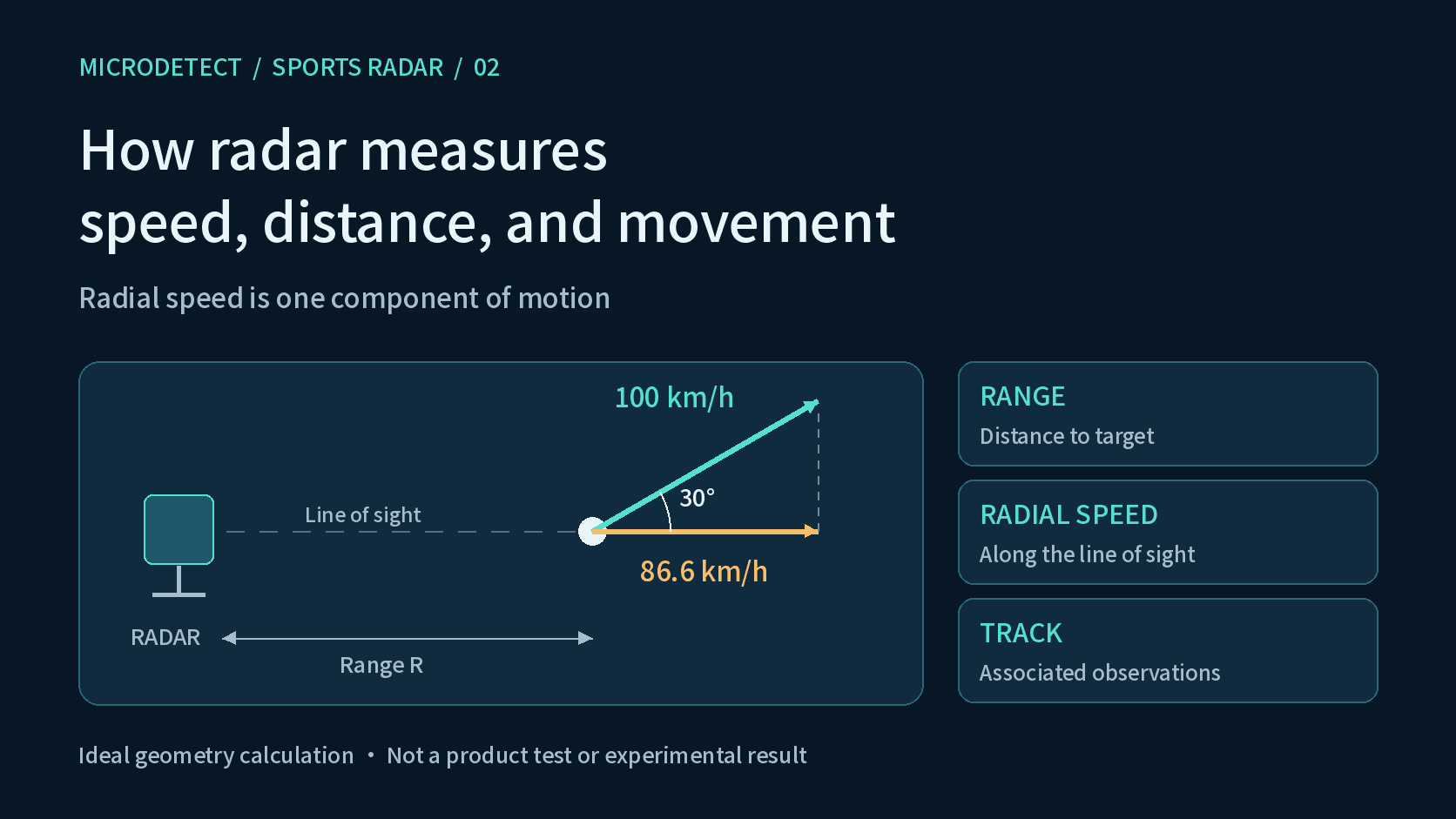
For a stationary monostatic radar, Doppler describes the target’s radial motion: toward or away from the sensor. In an ideal straight-line example, radial-speed magnitude is |v_r| = v × |cos(theta)|, where theta is the angle between the velocity vector and the outward line of sight. Confirm the device’s convention for positive and negative values.
Imagine a ball moving away at 100 km/h at an angle of 30 degrees to that sightline. Its radial speed is approximately 86.6 km/h. This is a geometric calculation, not a device benchmark. At an instant when motion is perpendicular to the sightline, radial velocity can be zero despite substantial sideways speed.
Do not correct every reading by dividing by an assumed cosine. That correction needs a trustworthy direction estimate and becomes unstable near perpendicular motion. Mounting geometry and target identification still need validation.
Movement: connecting observations across time
Range and radial velocity describe a detection. A trajectory requires observations over time and a decision about which detections belong to the same object. Angle information can help establish spatial position; tracking adds association and estimation.
For example, a ball, a racket, and a player may move during the same event. A smooth line drawn on a screen is insufficient evidence that the ball was continuously observed. Ask the supplier to distinguish observed points, filtered positions, predictions through a gap, and any modeled continuation.
MathWorks’ range-Doppler guide explains how returns can be organized by distance and radial speed. Such a map helps separate returns, but it does not by itself identify a named athlete or establish a full three-dimensional path.
Four specifications to request separately
A buyer should avoid treating one headline specification as a complete measurement claim:
- Range resolution: whether nearby targets can be separated in range.
- Range accuracy: how close a reported distance is to an appropriate reference value.
- Unambiguous velocity range: the radial speeds supported without unresolved Doppler wrapping under the chosen configuration.
- Update rate and latency: how frequently results arrive and how old the underlying observations are when displayed.
MathWorks distinguishes accuracy, bias, and resolution. Under the ideal bandwidth relationship, delta_R = c / (2 × B). Using c approximately equal to 300 million m/s, a hypothetical 4 GHz sweep gives 3.75 cm nominal range resolution. It does not establish 3.75 cm position accuracy or prove that two sports balls will always be separated.
The distinction matters when a display shows several decimal places. Extra digits do not demonstrate lower uncertainty.
A proposed sports validation session
The following procedure is our editorial recommendation, not a reported experiment. Start with one ball type, one lane, and one primary output.
- Define the quantity. Choose radial speed at a stated location, total speed from a validated trajectory, or distance at an event time. Release speed, peak speed, and speed averaged over a lane must not be substituted silently.
- Match the reference. Use a suitable calibrated comparator or synchronized reference system. Two timing gates provide interval-average speed; compare that with the radar’s matched interval, rather than assuming it equals a single instantaneous reading.
- Record the geometry. Retain mounting position, orientation, measurement volume, firmware, waveform configuration, and reference alignment.
- Exercise the envelope. Test the intended distances, directions, speeds, and interference conditions. Include reinstallation trials if the system is portable.
- Keep the failures. Report invalid measurements, missed events, wrong-target selections, error distribution, and latency. Agree on acceptance criteria before reviewing results.
For a coaching decision, ask whether a change is large enough to distinguish from the measured uncertainty. If geometry, configuration, or the metric definition changes, establish comparability before calling the difference an improvement.
What is established, and what remains to be shown
The cited documents establish general FMCW processing principles and implementation methods. The angle and bandwidth examples above are ideal calculations. The sports session is a proposed validation design; no new athlete dataset, experimental sports result, or validated MicroDetect product specification is reported here.
The practical lesson is to label each output precisely: range, radial speed, tracked position, or derived training metric. Next, we will compare what radar, cameras, and wearables each contribute to a sports measurement system.