Why Sports Radar Is Moving from Speed Guns to Millimeter-Wave Imaging and Tracking
What mmWave tracking adds beyond a speed reading: radial velocity, FMCW sensing, measured versus modeled trajectories, sensor fusion, and a practical sports-radar pilot.
Why Sports Radar Is Moving from Speed Guns to Millimeter-Wave Imaging and Tracking
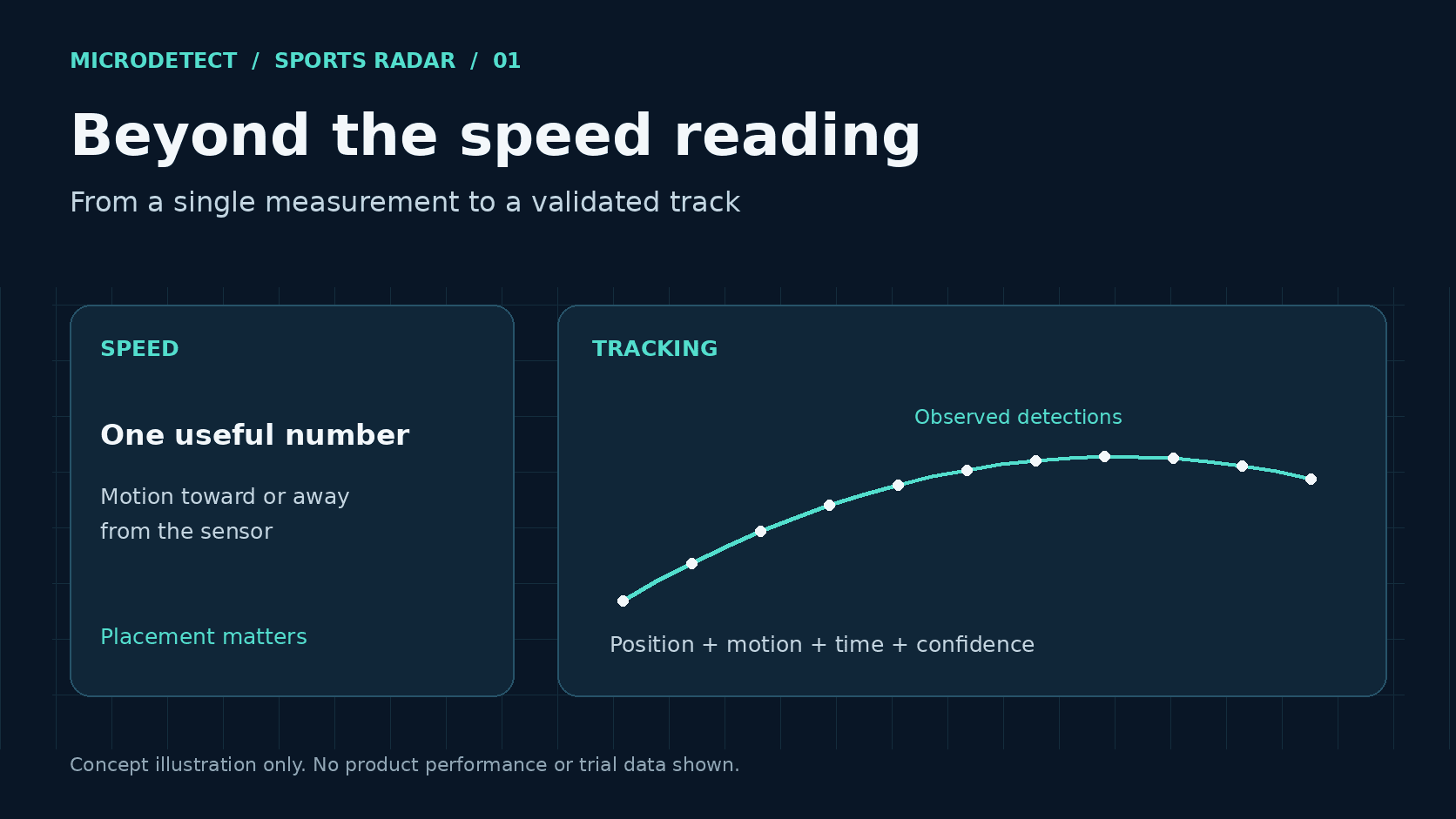
A speed reading answers one useful question: how fast was that pitch, serve, or shot? A coach usually has a second question: what changed between this attempt and the last one? Answering it may require the ball’s direction, the part of its flight actually observed, and a repeatable record of the session.
That is the practical reason to move beyond a single speed number. Millimeter-wave radar can contribute to richer tracking systems, but the useful advance comes from the complete measurement chain: antennas, waveform, signal processing, tracking software, installation geometry, and validation. A higher operating frequency alone does not deliver a complete performance analysis.
This first article in our sports-radar series explains that transition and offers a way to evaluate it without confusing a convincing visualization with a verified measurement.
What a speed gun measures—and what it leaves open
Doppler radar measures motion toward or away from the sensor. This line-of-sight component is called radial velocity. As TI explains in its range, velocity, and angle primer, velocity is one observable alongside distance and direction.
Consider a simplified straight-line shot traveling at 100 km/h. If its direction is 20 degrees away from the radar’s viewing axis, the radial component is about 94 km/h: speed multiplied by the cosine of the angle. This is an illustrative geometry calculation, not a product test. A system may compensate using independently estimated direction, but a basic radial reading cannot supply that missing information by itself.
For a coach comparing sessions, placement therefore matters. Moving the instrument between repetitions can create an apparent performance change. Recording the mounting position, aim, and measurement point makes the results more interpretable.
A simple speed gun can still be the right tool when the goal is a repeatable speed check in a controlled lane. More elaborate tracking is useful when the question requires more evidence.
What FMCW and multiple antennas add
TI’s mmWave fundamentals white paper describes frequency-modulated continuous-wave radar, or FMCW. It transmits frequency sweeps called chirps. Processing the returns estimates distance; changes across chirps provide velocity information; differences between receiving antennas support angle estimation.
With suitable hardware and processing, these observations can become detections with a position, radial velocity, timestamp, and signal-quality information. A tracker then associates detections over time to estimate a trajectory. Association is an additional inference: the system must decide which returns belong to the same ball rather than to a club, player, net, or another ball.
Short wavelengths allow compact antenna arrangements, but small packaging is not a guarantee of fine angular separation. Bandwidth, antenna aperture, signal strength, configuration, and processing all matter. Nor is the ability to separate nearby targets the same specification as the accuracy of a reported position.
A practical distinction for buyers follows: ask separately about detection, continuous tracking, and the final metric. A device may detect a fast-moving object without retaining a reliable track through the entire action.
“Imaging” means a spatial representation, not necessarily a picture
In a sports-radar proposal, imaging might mean a spatial map of reflected energy or a collection of detected points. It does not necessarily mean a camera-like image, detailed body pose, or identification of every object in the scene. Ask the supplier to show exactly what the sensor produces before the application draws a polished animation.
Imagine a golf bay that displays a complete flight ending at a predicted landing point. The first section may be observed while the remainder is generated by a flight model. That can be useful for training, provided the interface identifies the observed segment and the modeled segment. Otherwise, users can mistake a calculated outcome for a directly tracked one.
The same discipline applies to spin and launch metrics. Establish which quantities are directly measured, which use sensor fusion, and which are inferred. “Radar-equipped” does not establish that every displayed parameter is measured by radar.
Commercial sports systems already combine sensing methods
Trackman’s Trackman 4 product page describes a system combining two radars and a camera. This is a concrete example of sports measurement extending beyond a standalone speed display. It is the manufacturer’s description, not independent verification of its accuracy, and the cited page does not establish a millimeter-wave operating band.
The broader engineering lesson is to choose sensors for the evidence needed. A camera may supply visual context while radar contributes motion measurements. Combining them also introduces synchronization, calibration, and association work. A fused output should be evaluated as a complete system.
There is no universal migration in which every sports radar must become a mmWave imaging device. Legacy frequency bands and simpler sensors remain relevant. The opportunity is to solve a specific training problem with a measurement system that can demonstrate its performance.
Start with one decision the coach needs to make
For an initial pilot, choose a narrow question: can the system compare ball speed across repetitions in one training lane, or track the early trajectory of a shot in a defined volume? Avoid making a full-venue tracking demonstration the first acceptance target.
Agree on the following before collecting data:
- Measurement definition: release speed, peak speed, speed at a specified point, or another explicitly defined quantity.
- Operating envelope: ball type, distance, speed range, launch directions, and number of simultaneous targets.
- Reference method: an appropriate calibrated comparator with synchronized timing and a matching measurement definition.
- Success criteria: acceptable error, valid-track rate, false detections, latency, and repeatability after reinstalling the sensor.
- Failure behavior: what appears when the ball is lost, another target is selected, or confidence falls below the agreed threshold.
Test both ordinary repetitions and deliberately difficult cases. Include a player crossing the sensing area, off-axis shots, nearby moving equipment, and multiple balls if those conditions belong to the intended use. Retain failures in the report. A small error among successful tracks says little about a system that misses many attempts.
The product is the feedback loop
For an athlete, the result should lead to a usable next action. For a coach, the same metric should mean the same thing next week. For an operator, the installation should be reproducible and the record auditable.
That suggests a practical product requirement: preserve the event time, measurement definition, installation profile, software version, validity state, and whether a value is measured or modeled. A missing track should be shown as unavailable rather than silently replaced by the previous result.
For MicroDetect, these are criteria for evaluating a sports-radar development project, not claims that existing industrial instruments are already validated sports products. A successful pilot should demonstrate one useful measurement under documented conditions before expanding the feature list.
The shift beyond speed guns is valuable when it turns more observations into better coaching decisions. Next in this series: how to choose among 24 GHz, 60 GHz, and 77 GHz for a defined sports application.
Sources and further reading
- Texas Instruments, The fundamentals of millimeter wave radar sensors: FMCW ranging, velocity, and antenna-based angle estimation.
- Texas Instruments, mmWave fundamentals: Range, velocity and angle: measurement definitions and distinctions.
- Trackman, Trackman 4: manufacturer example of radar and camera integration.
The pilot design and coaching examples above are editorial engineering recommendations, not reported trial results or independent product benchmarks.